
ChatGPT Ads Management
OpenAI ChatGPT Ads Campaigns for Early-Mover Brands
ChatGPT Ads have been released in Australia and is arguably the biggest news in paid media channels since search advertising began. As more people use AI tools to research products, compare services and ask for buying advice, paid visibility inside ChatGPT could become a major source of high-intent traffic.
Kook is already trialling ChatGPT Ads and OpenAI Ads Manager for its own advertising (ie service-based), as well as a couple of select product-based ecommerce clients.
A key takeaway is that this is far from a predictable ad platform yet. Each day we've logged in and there have been changes, most notably the addition in late May to add CPC (cost-per-click) campaigns after the initial launch came with only an option for CPM (cost per thousand ie impressions). There's very few businesses or agencies posting about their campaign results so it's very much the Aussie pioneering spirit that is driving our testing.
ChatGPT advertising is not simply “Google Ads inside AI”. It requires a different way of thinking about intent, search behaviour, campaign structure, tracking and conversion quality. For the right business, this could become a game-changing PPC channel. For the wrong setup, it will budget quickly on people with no intention of ever buying anything - service or product.
Kook's job in the early phases will be helping businesses with a clear focus on only showing ads to GPT users once they have shown true commercial intent.
What Are ChatGPT Ads?
ChatGPT Ads are paid placements shown inside ChatGPT experiences. They are managed through OpenAI Ads Manager Beta, OpenAI’s developing self-serve advertising platform. It's a really familiar interface for anyone who has used Meta or Google to set up ad campaigns.
Unlike traditional search ads, ChatGPT Ads are not built around simple keyword matching. The ad environment is conversational. People are not always typing short, obvious commercial searches such as “buy golf clubs Brisbane” or “best SEO agency near me”. They may be asking longer, earlier-stage questions before they know exactly what product, service or provider they need.
That changes the strategy in a big way.
ChatGPT Ads are matched using signals such as campaign structure, ad group context hints, landing pages, ad titles and ad copy. The platform is moving quickly, with CPC, CPM, conversion measurement and new campaign objectives now being introduced or expanded.
For Kook clients wanting to be early-adopters, this creates huge opportunity, but it's not without risk.
Why ChatGPT Ads Need a Different PPC Strategy
ChatGPT Ads are not managed like a normal keyword campaign.
In Google Ads, an advertiser can often target clear buying searches such as “buy golf training aid”, “best slice correction tool” or “SEO agency Sunshine Coast”. They can also use match types and negative keywords to control which searches they do and do not want.
ChatGPT Ads work differently. The advertiser is not simply choosing a list of purchase-intent keywords. The campaign needs to be shaped around the types of conversations where the product or service should be relevant.
This is usually done through tightly structured ad groups and context hints.
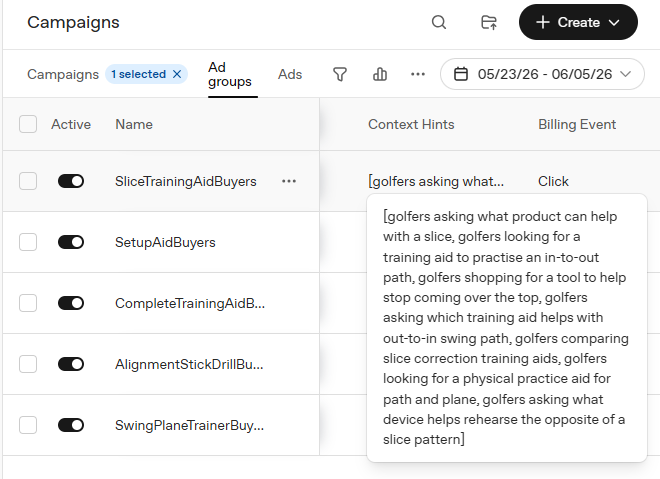
For example, a golf training aid campaign should not be one broad ad group for “golfers”. It may need separate ad groups for slice correction, setup problems, alignment training, swing path, swing plane and complete training aids.
Each ad group then needs context hints that describe the questions a user might ask in ChatGPT, such as:
- golfers asking what product can help fix a slice
- golfers looking for a training aid to practise an in-to-out swing path
- golfers comparing slice correction training aids
- golfers asking which device helps rehearse the opposite of a slice pattern
- golfers looking for a physical practice aid for swing path and plane
This is the practical difference.
The advertiser is trying to describe the buying situation before the buyer has turned it into a clean search query. A user may not ask “buy slice correction training aid” straight away. They may ask why they keep slicing the ball, what causes an out-to-in swing path, which drills help fix it, or what training aid can help them practise the right movement.
That is where ChatGPT Ads could become powerful, but also where they become harder to manage.
Without the same level of keyword and negative keyword control advertisers are used to in Google Ads, campaign structure matters more. The ad groups need to be narrow. The context hints need to be specific. The landing page needs to match the intent. The tracking needs to show whether those conversations are turning into useful traffic, leads or sales.
That is why ChatGPT Ads are not just another PPC placement. They require a different way of thinking about intent.
Kook’s ChatGPT Ads Management Service
Kook helps businesses test and manage ChatGPT Ads as part of a broader PPC and AI visibility strategy.
Our service includes:
- ChatGPT Ads opportunity assessment
- OpenAI Ads Manager Beta campaign planning
- Campaign and ad group structure
- Context hint strategy
- Ad copy testing
- Landing page alignment
- UTM and analytics planning
- Conversion tracking recommendations
- Google Tag Manager and GA4 measurement support
- Performance monitoring and reporting
- Ongoing optimisation as the platform changes
Because the platform is still in beta, our approach is deliberately structured. We do not recommend throwing broad campaigns into ChatGPT Ads and hoping the system finds the right people. The targeting controls are still limited compared with mature platforms such as Google Ads and Meta Ads.
The early winners are likely to be brands that build focused campaigns around clear intent, strong landing pages and measurable conversion actions.
Current Limitations of ChatGPT Ads
Advertisers should expect limitations compared with mature PPC platforms with fewer optimisation controls than Google Ads or Meta Ads.
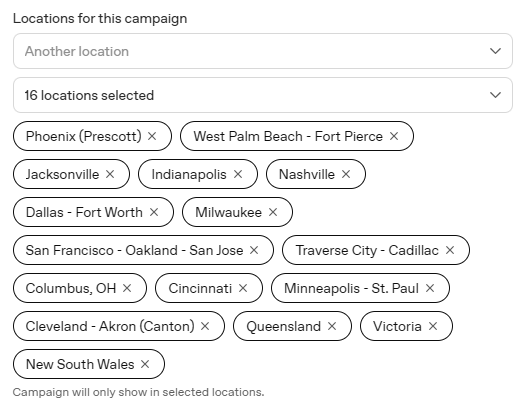
As of early June, Australian geographic targeting is still limited, with no options for Australian cities or smaller areas such as the Sunshine Coast. Australia, Canada and New Zealand are live with “regional” advertising pilots, but the wording can be confusing. In Australia, the platform treats States such as Queensland and Victoria as “regions”. In New Zealand, where there are no States in the same sense, the platform can split targeting into smaller regions. In the United States, advertisers can target by State or Designated Market Area. Even OpenAI's own tech guides mention postcode or zipcodes can be selected, but we have not seen that functionality in the ad platform. Whether that platform differs to users in the US we can only ponder.
For Australian businesses, this means local targeting is still blunt. A business that only services Brisbane, the Sunshine Coast or Melbourne cannot yet rely on the same level of location control it may use in Google Ads. Campaign structure, landing page filtering and lead-quality checks become much more important.
Negative keyword functionality also appears unavailable in the way Google Ads advertisers would expect. That means campaign structure and context hints need to do more of the heavy lifting. You cannot approach this like a traditional search campaign where broad matching can be controlled by a long negative keyword list.
This increases the need for tight, structured campaigns.
Pros of ChatGPT Ads
ChatGPT Ads could become a major PPC opportunity because they sit inside a high-attention, high-context environment.
Potential advantages include:
- Access to users during research and decision-making
- Strong alignment with high-intent questions
- Less mature competition than Google Ads or Meta Ads
- New CPC and CPM buying options
- Conversion measurement options through OpenAI tools
- UTM tracking for GA4 and broader analytics
- Potential early-mover advantage before the channel becomes crowded
- A new way to reach users before they move to search engines or comparison sites
For businesses with strong offers, clear landing pages and measurable conversion actions, ChatGPT Ads could become a meaningful addition to the paid media mix.
Cons and Risks of ChatGPT Ads
Current challenges include:
- The platform is still changing quickly
- Targeting is less mature than Google Ads
- Australian city and local-area targeting is not yet available
- There may be no familiar negative keyword workflow
- Reporting benchmarks are still limited
- Conversion volume may be inconsistent during beta
- The best context hint strategies are still being tested
- Poor landing page alignment could waste budget
- Some users may still be sensitive to ads inside AI experiences
This is not a “set and forget” channel, and small oversights could be costly for businesses looking at DIY services.
ChatGPT Ads Tracking and Measurement
Tracking is critical.
ChatGPT Ads should not be launched without a clear measurement plan. At a minimum, advertisers should think through how traffic, leads, sales and assisted conversions will be measured across OpenAI Ads Manager, Google Analytics 4 and internal reporting systems.
A practical measurement setup may include:
- UTM parameters on ChatGPT Ads landing page URLs
- GA4 campaign tracking
- Google Tag Manager event tracking
- OpenAI conversion measurement where available
- Pixel-based tracking where appropriate
- Server-side conversion tracking or Conversions API where suitable
- CRM or lead-quality tracking for service businesses
- Separate landing pages for clearer attribution
- Call tracking where phone enquiries matter
Who Should Test ChatGPT Ads?
ChatGPT Ads may be worth testing for businesses that have:
- A clear product or service offer
- Strong landing pages
- A defined conversion action
- Enough budget to test properly
- A willingness to work with early, imperfect data
- Products or services people research before buying
- High-value enquiries or transactions
- A need to reach users earlier in the buying journey
This may include B2B services, SaaS, ecommerce, education, finance, professional services, travel, home improvement, technology, retail and specialist product categories.
How Kook Approaches ChatGPT Ads
Kook treats ChatGPT Ads as a strategic PPC test, not a novelty channel.
Our approach is based on four priorities.
1. Intent Mapping
We identify the questions people ask before they are ready to buy. This includes early research questions, comparison questions and provider-selection questions.
2. Campaign Structure
We build campaigns around clear commercial themes rather than broad keyword dumps. Each ad group needs a defined purpose, a clear audience moment and a matching landing page.
3. Measurement
We connect ChatGPT Ads traffic to GA4, Google Tag Manager and available OpenAI measurement tools so performance can be reviewed properly.
4. Iteration
Because the platform is changing quickly, campaigns need regular review. CPC, CPM, conversion objectives, targeting controls and reporting features may keep changing as OpenAI expands the product.
ChatGPT Ads and PPC Strategy
ChatGPT Ads should not be viewed in isolation. The real opportunity may come from understanding how these channels influence each other.
For most businesses, it should sit beside Google Ads, Meta Ads, SEO, AI search optimisation and conversion rate optimisation.
For example, a user might first ask ChatGPT for advice, click an ad, visit a landing page, leave, search the brand later on Google, then convert through another channel.
That means attribution may not be clean. Businesses need to look beyond last-click reporting and consider how ChatGPT Ads may influence the broader customer journey.
This is where the strategic value sits. ChatGPT Ads may not only capture demand. They may help shape demand.
ChatGPT Ads Agency Support
Kook can help businesses work out whether ChatGPT Ads are worth testing now, or whether it is better to wait until the platform matures.
For suitable businesses, we can help with campaign planning, setup, tracking, reporting and optimisation. For businesses that are not ready, we can help prepare the measurement, landing pages and AI search visibility needed to move quickly when the platform becomes more widely available.
This is an early channel. The businesses that learn now may have an advantage later.
Talk to Kook About ChatGPT Ads
ChatGPT Ads could become one of the most important new PPC channels for businesses that rely on high-intent traffic.
The platform is still developing, but the direction is clear: AI-assisted discovery is becoming part of the customer journey.
If you want to understand whether ChatGPT Ads are right for your business, Kook can help you assess the opportunity, plan the test and measure the results properly.
Similar posts
How to report fake Google Reviews and get them removed.
Don't let fake Google Reviews undo your hard work.
How to set up your Google app password.
You can setup your Google app password by following the steps outlined in this article.
We're ready to move,
are you?
No lock-in contracts.
No outsourcing.